NoMa Now (2025)
A snapshot view of the NoMa neighborhood, and of the work we do to build, support, care for, promote, and celebrate it.
Introduction
This addendum report looks back at 2025, the fourth year of the NoMa BID’s current strategic plan, “Making NoMa Magnetic.” The strategic plan, published in 2022, was designed to advance immediate-term opportunities that contribute towards our vision while also positioning NoMa for the next five years and beyond. Born amidst the global COVID-19 pandemic, the plan was built with inherent flexibility to adapt to the changing needs of a neighborhood and a world in flux. The plan also served to codify one of the fundamental truths about NoMa: this is a neighborhood that is still
growing and maturing and will be for years to come.
In 2025, we continued to make progress on all 11 of our strategic initiatives; strengthened our partnerships; welcomed new businesses, visitors, and residents to NoMa; and redoubled our cultural and arts activations with a focus on our own community. Four years in, we are more confident than ever that NoMa’s magnetism is only growing, and that through this plan, our staff and stakeholders are doing more than ever to ensure NoMa’s future success.
This addendum report details that work and its impacts, capturing the myriad ways that the BID’s efforts push NoMa to new heights, open new doors, and create new opportunities for the neighborhood to thrive.
March 2026 — Updated to include more recent information and the work completed since the inception of the plan in late 2021.
NoMa Business Improvement District strives to be both a vocal champion and an effective steward of the NoMa neighborhood on behalf of all of its businesses, employees, residents, visitors, and the city as a whole.
In our role as cheerleader, we promote NoMa, attracting attention and business activity. We host our own events and sponsor the events of others. We create and celebrate public art. And we connect visitors, workers, and residents to experiences and opportunities they can enjoy.
Our stewardship of the neighborhood is evident in the work of our Ambassador Operations team, cleaning and beautifying the streets and public spaces. And behind the scenes, our staff is coordinating and communicating, building relationships and engaging stakeholders to create long-lasting investments and commitments to what NoMa can become.
Supporting & Growing NoMa Businesses
The NoMa BID provides a vital layer of support for the businesses within Greater NoMa. We know that a thriving business community runs on diversity—diversity of ideas, of sectors, of sizes, and of target markets. We work hard to connect businesses to the people who live and work in NoMa, and to cultivate a physical and cultural environment where everyone can flourish.
We connect NoMa’s businesses with advice, guidance and promotional support, we conduct and analyze research, and perhaps most impressively, we build and maintain dazzling public spaces. We’re always on the lookout for new ideas and approaches to serving businesses and their employees, and we create adaptive communication channels for owners, tenants, managers, and workers to connect with us and provide feedback.
Cultivating Community & Identity
NoMa has experienced dramatic change since the NoMa – Gallaudet University Metro Station was built in 2004. Its identity continues to develop as a growing volume of new residents, businesses, institutions, and public space improvements make their mark.
When residents, employees, and visitors of these parts think about NoMa, they don’t think of lines on a map, but instead think of a growing and vibrant neighborhood that provides convenient access to the rest of DC and the region. When employers think about NoMa, they see an affordable and accessible alternative to downtown.
Throughout the input phase of this plan, we heard from employees, residents, and stakeholders that community & identity represented a next frontier for NoMa, but conversely that the BID could not directly create them. Instead, the strategy we’ve embraced is to create the spaces, experiences, and opportunities that will help community and identity develop, grow, and flourish.
Our Successes & Assets
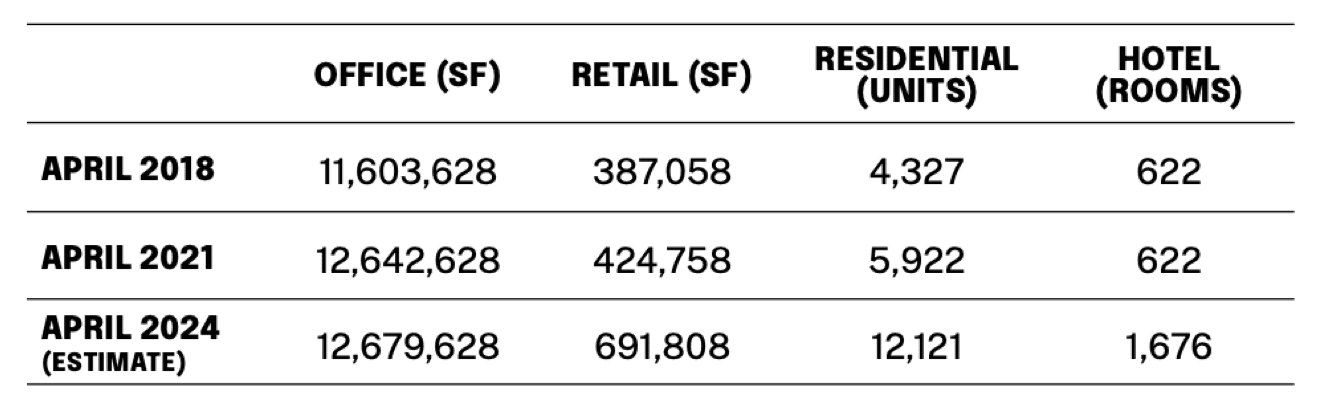
NoMa’s success is evident in everything from the large number of cranes dotting the skyline to the thriving businesses that line the streets and fill the office towers. As this plan kicks off, the neighborhood is in the middle of another construction boom, continuing to attract large volumes of private investment. Currently (Summer 2021), the NoMa BID comprises 12.6 million square feet of office space, 5,922 multifamily residential units, 622 hotel rooms, and 425,000 square feet of retail. When the buildings currently being built are completed, all of these numbers will have increased, some quite dramatically:
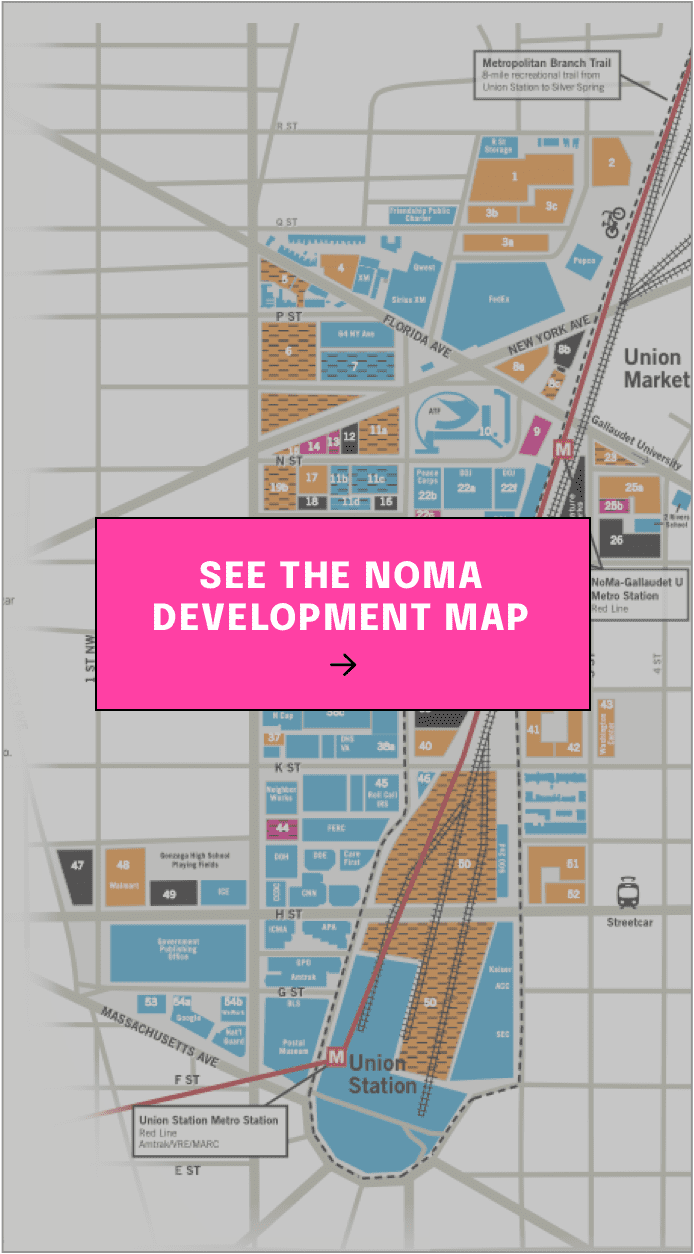
Public investment in NoMa has been just as foundational to the neighborhood’s success. The NoMa Parks Foundation is wrapping up its execution of the District of Columbia’s $50 million investment in NoMa for the creation of public park spaces. And tens of millions more will be applied to projects such as the reconfiguration of the intersection at New York and Florida Avenues NE to calm traffic and create stunning new public plaza and green spaces, the replacement of the H Street Bridge, the addition of bike lanes on Florida Avenue NE and K Street NE, and new Bus Priority measures on H Street NW.
But NoMa’s oldest and best asset remains the same: location, location, location. As the business focus and cultural attention of the city shift eastward, NoMa is perfectly positioned to become a new hub of DC life.
2025 was a standout year for NoMa. As the neighborhood moved closer to full buildout, more than two decades of investment translated into a district that feels complete, active, and increasingly defined by its people and public spaces. With much of NoMa’s physical framework now in place, the focus shifted decisively toward placemaking, stewardship, and long-term community vitality—solidifying NoMa’s position as one of Washington, DC’s most dynamic mixed-use neighborhoods.
Office and residential occupancy remained stable throughout 2025, demonstrating the neighborhood’s resilience amid broader market shifts. Following a significant wave of multifamily deliveries in 2024, residential vacancy held steady, ending the year at 10.3 percent. As new buildings continued to lease up, NoMa’s growing population supported increased activity across the neighborhood throughout the day and evening.
Retail momentum was a defining success of the year. The delivery of 18,500 square feet of retail space in 2024 led to the opening of 12 new businesses in 2025, expanding neighborhood amenities and reinforcing NoMa’s evolution into a vibrant, amenity-rich destination.
By the end of 2025, the NoMa BID encompassed approximately 12.68 million square feet of office space, 12,299 multifamily residential units, 1,356 hotel rooms, and701,000 square feet of retail—a scale that reflects both NoMa’s remarkable transformation and the BID’s role in stewarding its continued momentum.
NoMa’s Retail
In 2025, NoMa welcomed 12 new businesses, including tenants occupying previously vacant storefronts as well as spaces new to the neighborhood. These openings reduced retail vacancy to just under 29 percent—a 10-percentage-point improvement from 2024. With additional leasing activity underway, vacancy is expected to continue to decline in 2026, reinforcing the district’s growing appeal to operators and consumers alike.
NoMa’s Residential
Although no new residential units were delivered in 2025, leasing activity remained strong and consistent, underscoring the sustained demand for living in NoMa. The five residential buildings delivered in 2024 reached occupancy levels comparable to the broader neighborhood within roughly one fiscal year, signaling continued confidence in the market. This momentum is expected to carry forward in 2026 with the delivery of two new multifamily properties totaling 177 units.
NoMa’s Office Market
Like the broader Washington, DC, region and the nation, NoMa continues to contend with increased office vacancy rates as a result of the lingering effects of COVID. By the second half of 2025, however, vacancy stabilized at 15.7 percent—only modestly higher than the prior year’s 14.8 percent and outperforming the District overall.
NoMa’s diverse mix of public- and private-sector tenants, including a significant presence from both federal and DC agencies, continues to anchor the office market. This stability is further reinforced by the neighborhood’s live-work dynamic, with approximately half of NoMa residents also employed within the District. Together, these factors reflect the resilience and long-term reliability of NoMa’s commercial environment.
NoMa’s Parks & Public Spaces
The NoMa BID continues to act as a steward and champion of the parks that the NoMa Parks Foundation delivered to the neighborhood between 2012 and 2022. These parks have become anchors of community gathering, with more than 10 BID-hosted events and more than 50 community-hosted events in 2025.
Today, NoMa’s public spaces are varied, unique, and establish the neighborhood as a place where everyone is welcome to spend some time. And more public spaces are on the way in NoMa.
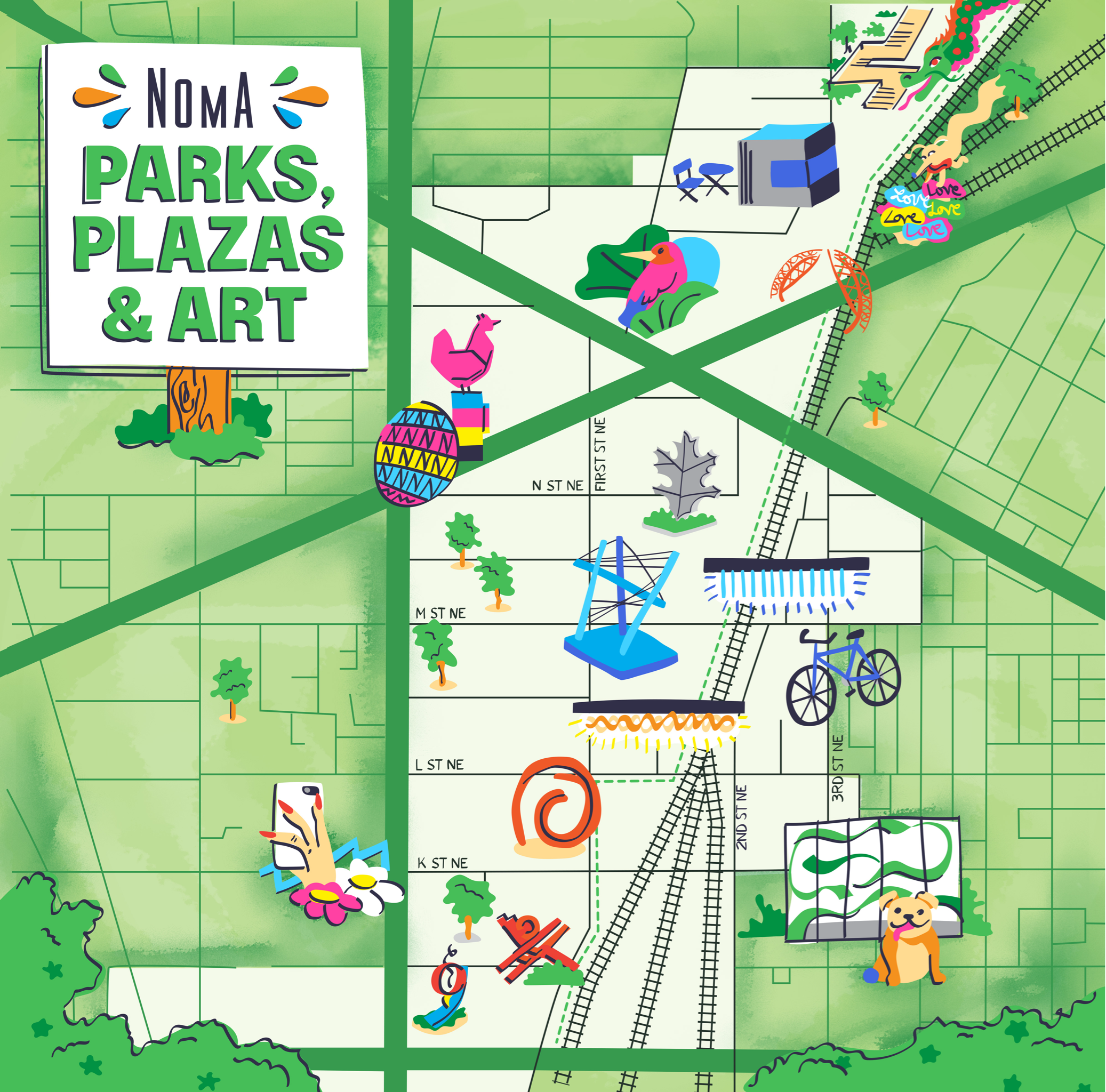
Explore highlights of the current and future parks, plazas, and arts in the map below.
plaza
Quincy Lane
Eckington’s new meeting point. An energetic and vibrant lane that welcomes the amenities of big-city life to this charming neighborhood in D.C.
100 block of Quincy Lane
plaza
Morse Street Plaza
Short linear park/plaza connecting Florida Avenue NE and Morse Street NE, includes a mural and industrial sculpture.
North side of Florida Ave. NE
plaza
N Street Metro Plaza
Busy small plaza with bike parking and seating in front of the Metro entrance.
East side of 2nd Street NE
plaza
NoMa Breezeway
Linear pedestrian space connecting N Street NE and M Street NE, includes the sculpture Journeys.
West of Metro station
plaza
NoMa Meander
Linear pedestrian space connecting M Street NE and Patterson Street NE and providing access to retail.
Unit block of M street NE
plaza
Uline Plaza
Busy small plaza with bike parking and seating, as well as café space for businesses.
200 block of M Street NE
plaza
Union Square Plaza
Quiet park/plaza providing an urban refuge, including ample seating, flowerbeds, and greenery.
800 block of North Capitol Street
plaza
CNN-CareFirst Plaza
Linear pedestrian space connecting buildings and businesses with First Street NE, including seating and the sculpture Trigadilly
800 block of 1st Street NE
plaza
G Place Plaza
Quiet plaza providing rest and seating for workesr in nearby buildings.
Unit block of G Place NE
art
Gateway Wings
2013, Kent Bloomer Studio
200 block of New York Avenue NE
art
The Chicken & The Egg
2019, RSM Design
Unit block of New York Avenue NE
art
Journeys
2004, Barbara Grygutis and Dolores Kendrick
N Street Metro Plaza
art
Torqued Tensility
2014, NaDaaa Design
1200 block of 1st Street NE
art
Rain
2018, Thurlow Small Architecture and NIO Architecten
100 block of M Street NE
art
Lightweave
2019, Future Cities Lab
100 block of L Street NE
art
Clement Sculptures
2018, John Clement
100 block of K Street NE
art
Composition for the Axemen
1989, Ken Wyten
800 block of 1st Street NE
art
Trigadilly
1990, Chas Coburn
CNN-Carefirst Plaza
murals
Supreme BBQ/Aunteaboba (West Wall)
Chris Pyrate
2 Florida Avenue NE
murals
Metropolitan Branch Trail (East Wall)
Multiple Artists
Metropolitan Branch Trail
murals
PEPCO (West, North, & East Walls)
Mulitple Artists
101 Harry Thomas Way NE
murals
1300 First (North Wall)
Aniekan
1300 First Street NE
murals
37 New York (West Wall)
NOSÉGO
37 New York Avenue NE
murals
33 New York (East Wall)
Birdcap
33 New York Avenue NE
murals
AVA NoMa (West Wall)
James Bullough
55 M Street NE
murals
Kerr Conway (East Wall)
Kate Deciccio
1005 North Capitol Street
murals
15K (North Wall)
RichT
15 K Street NE
parks
Alethia Tanner Park
Expansive park featuring a playground, separated dog park, café kiosk with ample seating, natural meadow space, outdoor screen and audiovisual structure, and a large lawn.
227 Harry Thomas Way NE
parks
Swampoodle Park
Large dog park and a kids’ playground area featuring a Wallholla, a unique vertical play structure for kids.
1030 3rd Street NE
parks
Swampoodle Terrace
Neighborhood park on a quiet street corner, featuring an herb garden, checker/chess tables, outdoor workspace, and a boxcar for events.
1100 3rd Street NE
parks
The Lawn at Banner Lane
Multi-purpose public park that creates a neighborhood gathering space at Banner Lane, featuring a lawn, sculptural seating, and access to the courtyard level.
89 L Street NW
Greater NoMa
There is even more to the NoMa neighborhood beyond the BID’s boundaries. Today, the NoMa cultural footprint extends farther than our founders could have imagined. This concept of what comprises Greater NoMa is fluid, of course, and context-dependent, but there were some consistent ideas of what was included:
- Dense and relatively new mixed-use development in the BID and parts of Union Market
- Stable single-family residences east of the BID and in Eckington
- High-density affordable housing immediately west of North Capitol Street
- Diverse, popular retail offerings mixed with warehouses and wholesalers at the core of Union Market.
Since 2016, the Union Market area has grown into an incredible destination on NoMa’s doorstep, with about two million square feet of mixed-use development, including more than 1,900 residential units and about 220,000 square feet of office space. The residential projects were the first large scale multifamily developments to deliver, illustrating a notable shift from the primarily retail and warehouse uses that had characterized the area. With new properties also came new vibrant and unique retail tenants and restaurants. Up to three million additional square feet could deliver in the next five years, with continued focus on residential projects.
The built environment on the west side of North Capitol Street is also changing. Historically, affordable housing projects such as Sursum Corda, Tyler House, and Sibley Plaza have characterized the area. However, Sursum Corda is currently being replaced by a project that will include an even larger volume of affordable units, in addition to 900 new market rate units. This redevelopment, in addition to MRP’s Northwest One project (both currently under construction), promise at least two million square feet of residential development with a relatively high proportion of affordable housing units.
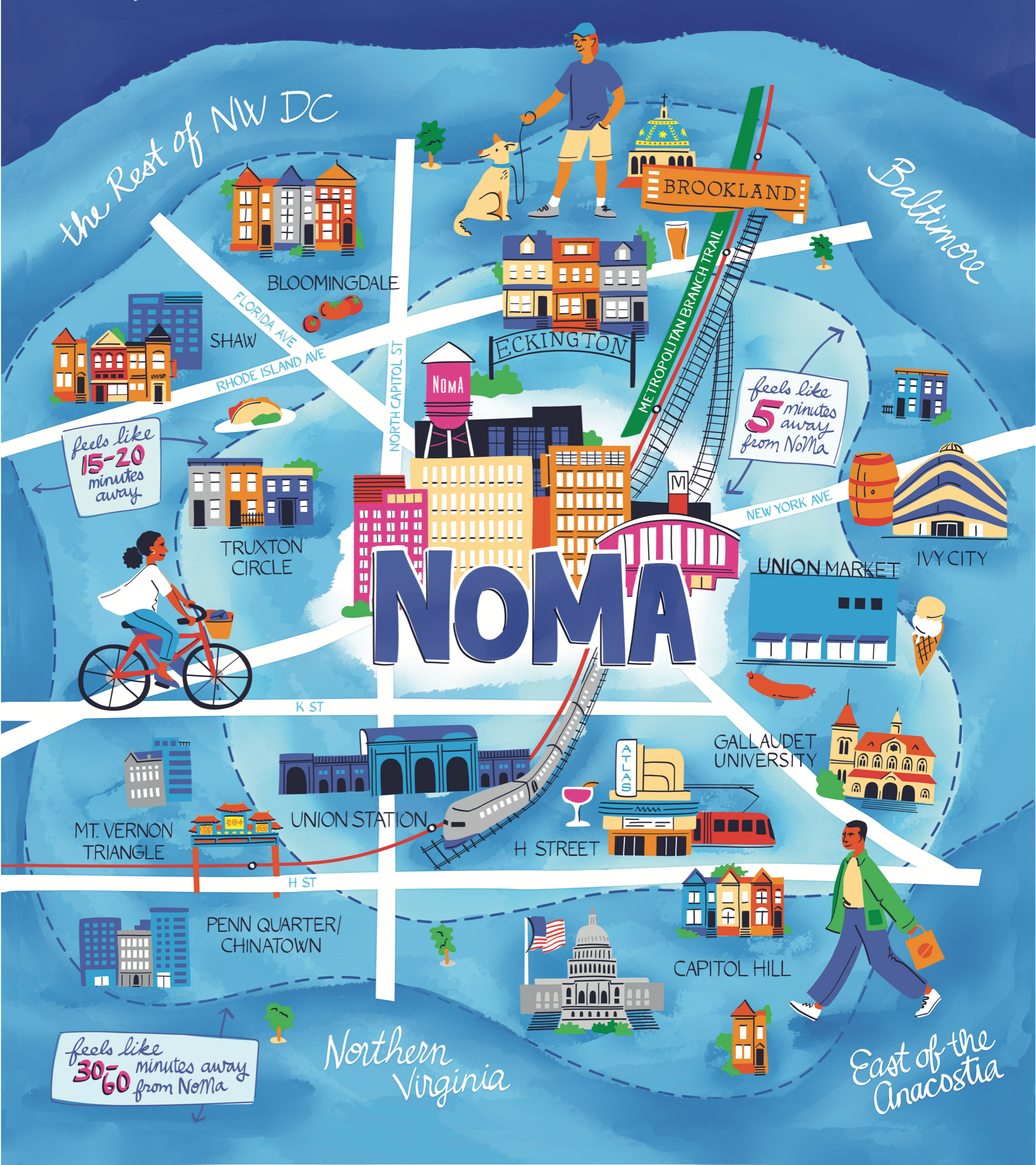
NoMa sits at the center of a web of growing and exciting neighborhoods. To the east, H Street NE is a rapidly developing, transit-oriented, and retail-dense corridor that is only a 15-minute walk from the core of NoMa, with DC’s historic Capitol Hill neighborhood only a few blocks to the south. Northeast lies thriving Union Market, and beyond that, the trendy industrial triangle of Ivy City. The more downtown-like Mt. Vernon Triangle lies due west, while Truxton Circle and Shaw extend northwest. Northward, neighborhoods like Eckington, Brookland, and Brentwood connect to NoMa via the Metropolitan Branch Trail, a critical biking and walking corridor that brings walkers, joggers, and bicyclists through our streets every day.